簡體中文
簡體中文 English
Product Description:
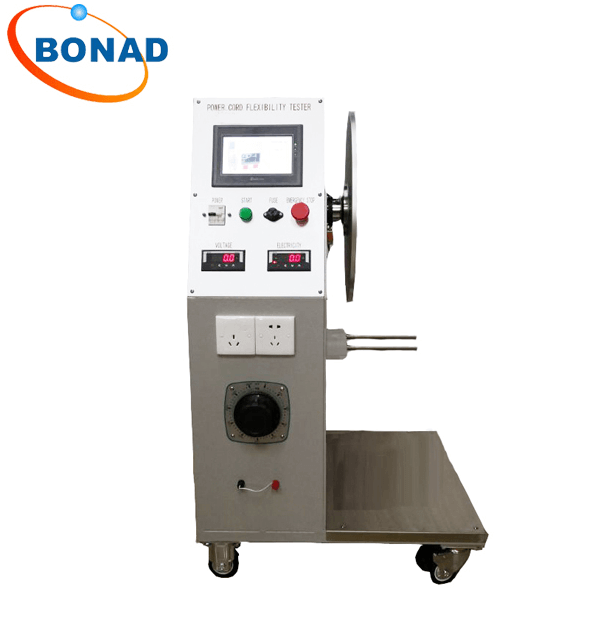
Name:IEC 60335 clause 25.14 Power Cord bending Flexibility Test Apparatus
Type:BND-DWJ
Manufacturer:Power Cord Flexibility tester used is designed to comply with the following standards; IEC 60227-2 clause 5.6.3.2 , IEC 60227-2 clause 3.2 and IEC 60335-1 clause 25.14.
1 . Introduction
Small household appliances power cord flexibility tester is specially designed according to relevant standards. It applies to flexibility-resistant tests on cord of such household appliances and other similar appliances (or electric iron/coffee pot) with a power cord as need moving during operation. This tester is equipped with a high-precision digital instrument, high-performance digital frequency conversion, accurate rate adjustment, six digit memory settings, multi-function combination fixture, flexing angle adjustment and 3KW large power output, applying to the test requirements of most small household appliances.
The purpose of this test is to confirm the robustness of a supply cord at the point of entry to an electrical appliance. The point of entry for the cable is often a likely point of failure as the cable is excessively bent and flexed at this point against the hard corners of the appliance. (Please note: Cord bend testing is not a requirement for appliances with retractable power cable.)
The test and apparatus used is designed to comply with the following standards; IEC 60227-2 clause 5.6.3.2 , IEC 60227-2 clause 3.2 and IEC 60335-1 clause 25.14.
2. Test Theory
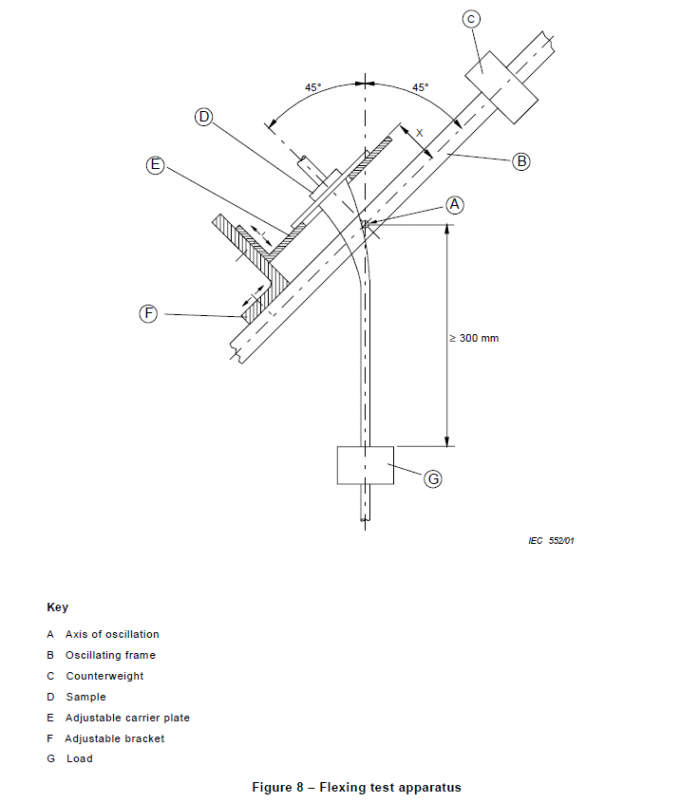
The part of the appliance that includes the inlet opening is fixed to the oscillating member so that, when the supply cord is at the middle of its travel, the axis of the cord where it enters the cord guard or inlet is vertical and passes through the axis of oscillation. The major axis of the section of flat cords shall be parallel to the axis of oscillation.
The cord is loaded so that the force applied is
– 10 N, for cords having a nominal cross-sectional area exceeding 0.75 m2;
– 5 N, for other cords.
The distance X, as shown in below figure, between the axis of oscillation and the point where the cord or cord guard enters the appliance, is adjusted so that when the oscillating member moves over its full range, the cord and load make the minimum lateral movement.
The oscillating member is moved through an angle of 90° (45° on either side of the vertical), the number of flexings for type Z attachments being 20 000 and for other attachments 10 000. The rate of flexing is 60 per minute.
The cord and its associated parts are turned through an angle of 90°after half the number of flexings, unless a flat cord is fitted. supplied at rated voltage and loaded with the rated current of the appliance. Current is not passed through the earthing conductor
3 . Technical Parameters
| Flexing angle/rate | Angle range: 45°, 60°, 90° / 5~60 /minute |
| Counting device | 0~999999 six-digit memory pre-set values |
| Maximum output voltage | 240V |
| Maximum output power | 3KW |
| Maximum output current | 12A |
| Maximum load capacity of sample | 15kg |
| Standard load weight | One of 5N, one of 10N |
| Standard conformance | GB4706-1clause25.14, IEC60335-1clause25.14 and Figure 8 |